Showing posts with label Juan les Pins. Show all posts
Monday, October 24, 2011
Trees for all (French) seasons
Trees bordering the road from Opio to Valbonne (April)
Trees near Pre-du-Lac (Grasse region, November)
The French had a great idea—tree-lined roads to shade travelers, mark property lines and provide guideposts. I thought this innovation dated from the time of Napoleon. But apparently, Henri II signed an edict in 1522. He was ahead of his time.
But with urbanization, increasing traffic and larger cars, I'm not how long these scenes will remain.
Town squares often have sycamore, with scaled, spotted bark. They are trimmed in January, and for months their branches look gnarled and arthritic until the leaves return in late spring.
Magagnosc, just east of Grasse, overlooks the Mediterreanean
The French Riviera, with its micro-climates, has palms and citrus inland as far as Grasse. Although the region looks very tropical, the temperatures may drop below freezing in winter nights, and the bone-chilling Mistral wind whips through the area. But clothes dry quickly on outdoor lines. . . . Unless they have blown away.
The Fragonard Museum, which contains works by artist Jean-Honoré Fragonard, is in the old city.
An older residence in Vallauris, a region made famous by Picasso, with citrus and palms.
Parasol pines provide a canopy of shade over the boules area, overlooking the Mediterranean
The unique trees make the region. And I may take up boules just to have an excuse to spend my days under these parasol pines.
Wednesday, May 19, 2010
The Blog of "No"by Jane Tolbert
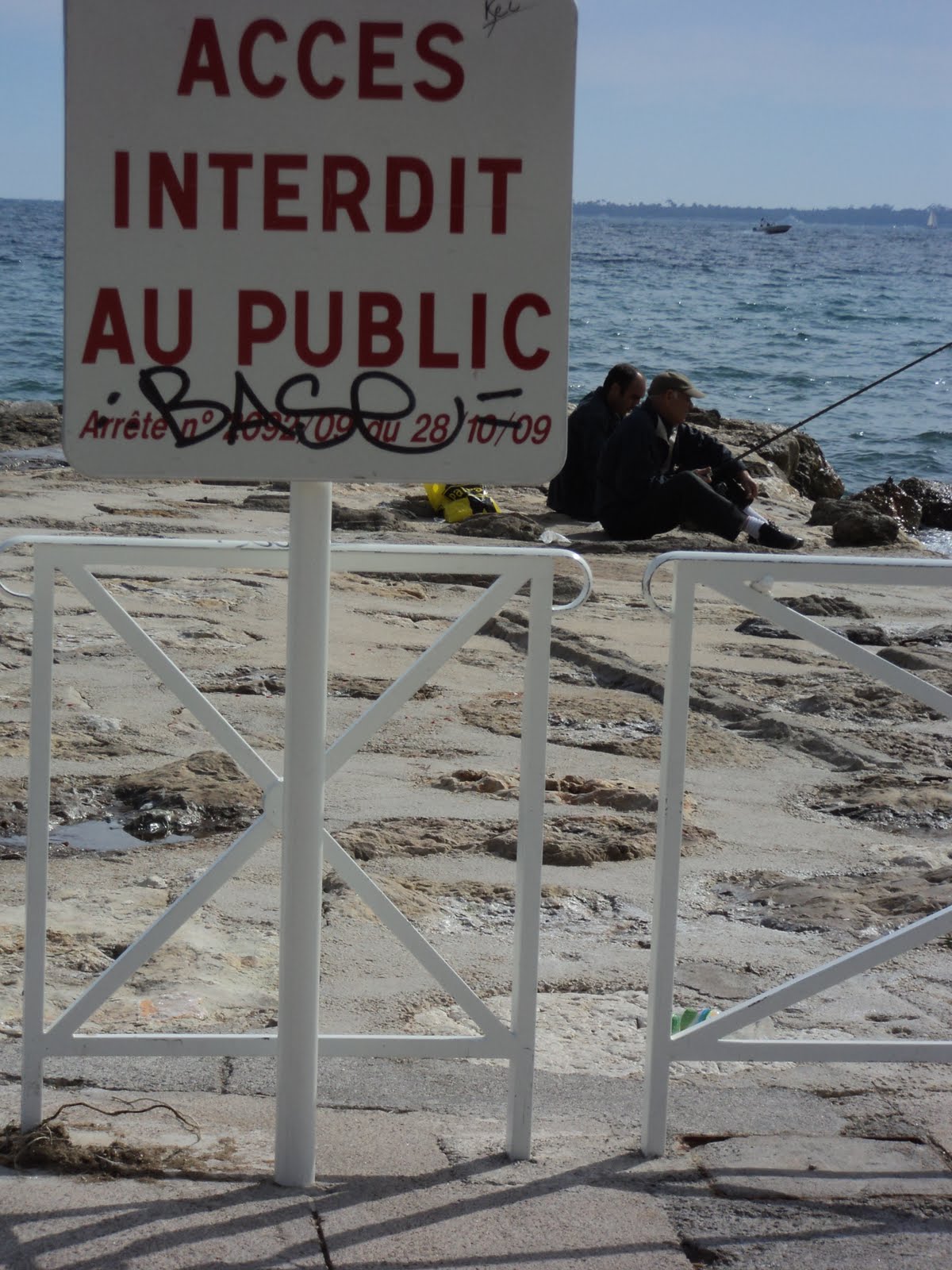
Signs tell what we can or cannot do in public places like city gardens or on the beach. One sign, the Defense dáfficher (or no posting), always carries the footnote-like citation, the Law of 29 July 1881. This law enables the town halls to designate locations where announcements can be posted. I have seen few of these public bulletin boards. The ones I have seen are in inaccessible places.
According to a municipal decree of 7 August 1987, no one can leave trash or damage the walkways and equipment. Kick ball games as well as petanque (!) are prohibited as are bikes and dogs. Tricycles are allowed.
Numerous activities are not allowed--camping, camp fires and dogs for starters. But barbecues are strictly forbidden.
Swimming and small children are permitted.
But here, both diving and jet skis are prohibited, but not yachts lining up for parties associated with the Cannes Film Festival. And no one mentioned swimming and diving dogs.
Some signs justify a decree (no parking) with a type of footnote citing the Code de la Route (driving regulations). Others provide the rationale--no parking because firemen need access, the tourist train leaves from here, a market takes place here in the morning. . . .
The fisherman can fish in peace. Tourists and bathers dare not venture beyond the Forbidden to the Public sign.
In an enviroment of "no," it is refreshing to see courteous signs. Please do not slam the gate or please keep the gate closed.

But maybe what lurks behind the gate is the reason for keeping the gate closed. This mean dog must have gotten out at least once. If the sign is any indication of what a Chien Mechant could do to a person. . . .
Labels:
Antibes,
chien mechant,
defense de,
Juan les Pins
Tuesday, May 11, 2010
Red Carpet and Weather. . . by Jane Tolbert

Photo sent via iPhone of May 4 storm.
The 63rd Cannes Film Festival takes place from May 12 through May 23, 2010. Hotels are usually crowded. Streets are packed with exotic cars. Throngs of tourists linger, hoping to get a glimpse of . . . .you name it, any of the stars or producers or just the rich and famous.
The region is primped. Palm trees. White sand. Lavish receptions. Well, that had been true until recently. With the recession, even the rich and famous are having to curtail activities. The main concern now is the weather.
Juan-les-Pins beach in February
The joke about the Cannes film festival has always been the weather. The locals agree, it rains during the festival. The Cote d’Azur might have had perfect weather between Easter and the festival—turquoise- azure seas, for which the region is famous, sunny skies and white beaches—all of which provide great photo opportunities. The opening of the festival generally brings gray skies and diluvial rains. In response to the meteorological challenge, several years ago organizers moved the festival to a later date in May.
Tourist season begins with Easter, intensifies during the festival and then continues through August. Preparation for the migration begins in late February or early March, with the clearing of the weather and subsiding of winter storms on the Mediterranean, which have eroded coastlines.
Beginning in late February, the operators of the private beaches import sand and palm trees, restore buildings, bring in tables, chairs and brightly colored umbrellas. They will rent the lounge chairs for 10 Euros the half day, serve grilled fish or meats and Mediterranean specialties, le tout arosé de vin et de champagne, to international clients as well as locals, all of whom relish a chance to dine with the view of the red Estérel Mountains, the azure sea and their feet in the warm sand.
But this year has been exceptional. The nice weather, which gave everyone hopes of a longer beach season, was cut short by what the Nice Matin (May 9, 2010) termed the “coup de mer dévastateur” of May 4,2010. The waves, which reached six meters, carried away tables, chairs, palm trees and the bright umbrellas. Quickly, an “armada” of workers and machines began to restore the beaches. Already in Nice, five of the 15 private beaches had reopened within days of the violent waves.
This year has brought other unexpected challenges, such as the eruption of the volcano Eyjafjallajokull , which began spewing tons of ash on April 14, resulting in stranded airline passengers and empty hotels. One luxury hotel manager in Juan-les-Pins said that although some of the hotels had canceled reservations, the clients stranded on the Cote d’Azur extended their stays.
Normal winter erosion (photo from December 2008)
The organizers of festival have changed their dates to meet challenges of the weather. And the beach operators got an early start on the season. No one could have predicted exceptional waves or the eruption of a volcano with a name that few can pronounce. In the next few days, we will see what the weather brings for the red-carpet event.
Friday, May 29, 2009
A Year Abroad by Jane Tolbert
In my travels to France over the years, I have seen a lot of change. American expressions have entered the vocabulary, and more American products are available—not only diet soft drinks, but Skippy peanut butter and Doritos. McDonald’s and fast foods are firmly entrenched, but the French waistlines also have expanded.
Driving no longer presents the white-knuckle experience. Many right of ways have been replaced by stop signs or traffic circles. Drivers seem more courteous, but the motorcycles and scooters swerve and weave like stuntmen from an action film. Among the worst offenders are the delivery boys for Mister Pizza. Both tiny cars and SUVs are more numerous. The dearth of parking spaces continues to force drivers to use ruse and stealth to snare a space.
Even with the emphasis on environmental protection and climate change, large development projects continue to spring up along the Mediterranean coastline, all but blocking the view, much like the condos on Florida’s beaches. Fields once filled with roses and jasmine for the perfume industries of Grasse have given way to villas and swimming pools. The inland region, with its rolling hills and olive trees, looks a lot like California.
In the post-war years, the French phone system seemed antiquated if it existed at all. But today, the telecommunications systems exceed my wildest dreams. For 30 euros a month, subscribers have a high-speed Internet connection, an excellent phone system with unlimited, free calls in France and to many foreign countries, as well as cable TV service. Healthcare is enviable. The “subscription” is based on an individual’s income rather than the flat rate charged by private health companies in the States.
More stores are open during the lunch hour. However, aside from a few cafés and North African groceries, little is open on Sunday afternoon, a time when I often ran my last-minute errands in Florida. A few rare service stations have mini-markets that carry wine, coffee, sandwiches, toilet paper and cat litter. The things that just can’t wait until Monday.
The post office and banks have maintained the traditional French schedule—mysterious operating hours, the two-hour lunch break and numerous holidays. Strikes, especially among railroad employees and university professors, continue to be prevalent. Shopping carts still do not roll in a straight line, and checkout counters in large supermarkets have the client elbowing their way through lines or diving to bag merchandise at it flies by on conveyor belts.
Singles are still welcomed by groups of friends, a much healthier social scene than the couples-only syndrome in the States. In the post-disco years, more Latin dance places have opened. And Argentine Tango is very popular. Its Tangueros look for any opportunity to dance at a variety of places—from Jack’s Blues jazz club to seaside parks.
In other ways France still maintains its uniqueness. Is it the fresh slivers of parmesan on my salad at the Café de la Plage? The hint of ground pepper in the vanilla ice cream from Fenocchio Glacier ? The tall, thin fluted glasses in which my peach kir is served at the Bamba? The way in which women dress up even for menial chores, and the interest the men show? The rows of fresh pastries that line the glass display cases? The sidewalk café terraces with dogs? The advertising with its humorous, sexual allusions?
I don’t know the answer. But fortunately in this world of change, France still retains an intangible quality of . . . Frenchness.
# # #
Labels:
Cafe de la Plage,
Cote d'Azur,
French Riviera,
Juan les Pins,
peach kir
Friday, April 24, 2009
Bonheur - Happiness
Quel Bonheur – The arrival of a long-awaited spring in the South of France. By Jane T. Tolbert
From mid November 2008 through mid April 2009, we had wet, cold, gray weather, typical of what I would call Northern Europe. “Unseasonal,” the natives claimed as if to justify the high prices visitors paid for the sunshine that should have been but wasn’t. “We always eat on the café terraces in January,” came the familiar refrain. “The first time in more than twenty years,” the meteorologists repeated all the while continuing their dire forecasts for the coming days. But spirits remained optimistic. “It could be worse—we could be in Paris or Brussels or London,” the locals agreed. Anything north of the mountains was viewed as the “netherland,” at least in terms of weather. But even in inclement weather, the people here remained optimistic and found happiness in the little things like walks or conversations with friends or bouquets of flowers.
In all weather conditions, a handful of bundled pedestrians appeared, often with a small shivering dog at the end of a leash. The dedicated joggers made their way up and down the boardwalk. The serious cyclists looking insect like in their large helmets and Spandex suits flew along streets and through deep puddles. But reminders of warmer weather appeared daily—the citrus and orange trees in terra cotta planters, geraniums that overflowed from balconies, and clusters of cafesitters.
On those rare sunny days that broke the monotony this winter, people and their pets, roller bladers, Africans hawking souvenirs, and candy vendors competed for space.
By Easter, anoraks, wool coats and scarves had been shed. Hopeful tourists donned light sweaters, flip flops or sneakers at the first sign of spring. Bright beach parasols popped open, and lounge chairs appeared on the private beaches that carried signs--transats et parasols demi-journée 8 euros, journée 10 euros. Dog scampered on the beach, kicking up sand. Small children raced to the edge of the water then darted back. Some people ventured into the water, oblivious to cold water. Café terraces became crammed with patrons sporting large designer sunglasses—Chanel, D & G, Roberto Cavalli, Guess. Other dogs tethered to café chairs squinted into the sun, their nozzles twitching at the scent of other canine friends.
Most boutiques and many small restaurants have been closed for a month or more during the winter. Tourists are scarce, and many locals hesitate to linger outside when the temperature drops below the 50s or rain threatens. Now with the return of spring, restaurant and store owners begin six weeks of frenzied activity to prepare for the tourist season. Crowds arrive before Easter, swell during the Cannes Film Festival in May, and streets become dense with moving throngs of color in the summer months. Although the weather remains beautiful into October, the crowds thin by late August. School or work vacations have ended, and the travelers have returned to their day jobs. By November, most have left the area, but some return at Christmas for the holiday festivities.
In late March, the beachfront restaurants, which pay an exorbitant rent I’ve been told, dig out terraces that have been buried under the sand or worse, washed away by the winter storms. The smell of paint and the sounds of saws, drills, and chink chink of masonry hammers fill the air. A large landscaping truck brimming with live palm trees blocks traffic in front of the Up Café. With a crane, it unloads the cargo to the beach of the Helios restaurant. Further down, the terraces of the Café de la Plage overlook the sea. The café, which has just gotten a face life, is in a gridiron-shaped building with a large clock on its façade. Most days its mascot, a black and white Newfoundland dog, ambles among the tables or lounges as waiters race to and from the kitchen to fill orders. This café offers an ideal vantage point from which to view the Mediterranean, the Lerin Islands, and the Esterel Mountain chain beyond Cannes. Just behind the café, the road veers off toward the park and the Cap d’Antibes. This street is bordered by small boutiques selling clothes, jewelry, and ice cream. Just beyond, an intersection is crowded with cafes—the Café Crystal and the PomPom—and restaurants and the Casino and hotel owned by the Partouche family. The annual jazz festival is held in July at the Pinède, a small park shaded by paraol pines. On the border of the sidewalk, clay tile squares carry the hand prints of jazz musicians--B.B. King, Little Richard, Ray Charles, and many others. On the sandy large area overlooking the sea and Cap d’Antibes, groups of men gather for their regular game of boules or pétanque.
Back at the Café Up (UpSideDown Café), I selected a seat facing west with a view of the sun setting over the Esterel and the Lerin Islands. I nodded a greeting to the gentleman and his dog sitting at the next table.
“What happiness!” he exclaimed.
I assumed he referred to his dog, who displayed a perpetual smile.
For two euros, I ordered a large coffee in a cup advertising Mokalito, which came with two individually wrapped sugar cookies.
“Quel bonheur,” my neighbor said again, this time motioning to the view.
The couple behind us seemed oblivious to the surroundings and instead debated the dessert menu. A waitress took orders of ice cream and drinks in tall glasses to another table.
Clouds gathered, and the rays of the sun cast hazy spotlights on the Esterel, now subdued with the fading light. On the boardwalk, parents and grandparents herded small children on tiny scooters and bicycles back to parked cars. A tan Corgi mix that makes daily rounds looked shocked and almost accusingly at an approaching car. He was in the pedestrian zone after all. I gathered my sweater and prepared to leave, somewhat euphoric at having spent more than an hour contemplating the scenery over a cup of coffee.
“The weather should be nice tomorrow,” the waiter commented. “It’s been unseasonably cold this year.”
I nodded, and agreed.
“Quel bonheur to see the return of spring!”
###
Labels:
bonheur,
cafesitting,
Cote d'Azur,
French Riviera,
Juan les Pins
Thursday, April 23, 2009
Cafesitting, the French Way
Jane T. Tolbert – Café Sitting, the French Way, an article based on more than 20 years of café sitting in various cities and villages of France.
Travelers returning to the States often find the absence of cafes noticeable if not annoying. Cafes are on every street corner in France and for centuries have been the mainstay of civilization. Writers, artists, absinthe drinkers, the illustrious, the luminaries, and the renegades have long adopted the cafesitting style of life. For the most part, clientele consists of average people and pets. The outdoor terrace has chairs and small tables, and a black board with a white inscription carrying the menu. Inside the woman behind the counter may be the girlfriend or the wife of the owner. Large dogs are often underfoot, spread comfortably across the entry, surveying the scene through half-closed eyes. These languid beasts spring into action at the whiff of a croque monsieur or even the sight of wrapped sugar cubes that accompany an espresso to the table.
Shelves behind the bar display bottles of flavored syrups--mint, strawberry or blackberry—fruit juices, or beers. Alcohols include scotch, martini vermount, and numerous brands of pastis. I am in the South of France, after all. In the middle of the counter, an elaborate chrome- plated espresso machine fizzes and hisses, and spurts alongside a pyramid of white porcelain cups.
Cafes have names like the Auberge Fleuri, le Flore, la Cupole, but most of the time, no one remembers the name. Instead the cafes are known as chez Mario or Amelie or Francois.
The wide spectrum of cafés includes those seedy-looking places in need of repair with the long-standing reputation. At the other end, the newer more luxurious parlors with their upholstered chairs and booths. In the 1970s, the worn tile floor of the Café de Flore was carpeted with cigarette butts. Chairs sagged under the weight of decades of patrons. The café had been a popular watering hole for generations. In the winter, the air was a suffocating mixture of heat and cigarette smoke while in summers, the terraces opened to the noise and exhaust fumes of the street. The poker-faced maitre d’ with the ashen complexion never forgot a face. In contast, Les Glaces had art deco wallpaper and a jukebox that played top hits. A wasp-waisted garcon raced back and forth filling orders and making change with the coins in his six-pocketed vest. His black pants lacked one half centimeter of dragging the floor.
Some cafes fill a function in addition to serving food and drink. The PMU sells lottery tickets and cigarettes as well as the local newspaper. Other cafes also act as an employment agency, matching workers with potential employers. Of course, these transactions take place under the table, and workers are generally not declared. But that’s another story.
The success of a café is not determined by its decor but by some intangible quality—that je ne sais quoi that attracts a loyal clientele. The blue collar cafes have their regular group—those men who appear several times a day—before work for an espresso, which they enjoyed with their cigarette before the laws changed, at noon for an aperitif, and again in the evenings to meet with friends. They also appear on Sunday mornings, baguette and newspaper in hand. With their ever-present berets squashed down over reddish complexions, they lean heavily on the counter an order—a little glass of white wine or something stronger. Or they order mineral water, explaining to anyone who might be listening their douleurs au foie or liver problems. Conversation is punctuated by curses like putain, acceptable in the South of France, or the more genteel zut or mince in mixed company. Talk centers on weather, the hunting season, or the plague of tourists and Parisians responsible for all ills such as traffic jams and the poor economy.
Other cafes are frequented by regulars who seem to have no schedule but have perfected the skill of café sitting. They come expressly to watch or talk, food and drink are secondary. They distract themselves in conversation or with that well-cultivated look of ennui or boredom, the French have mastered.
(Drawing by Margaret R. Tolbert)I remember when I approached a café for the first time—an experience bordering on the traumatic. The feeling was much like that of stepping into the wrong hotel room. A hush fell, glasses and cigarettes paused, and heads craned. I settled in, ordered a large cappuccino, and studied the regulars. How did they move? A perfectly choreographed dance of clients, waiters, dogs, and shopping bags seemed to move, never colliding. With a fluid motion, the regulars unfurled their bodies at a small round table and arranged themselves in the most alarming pose. They draped their body in an S-shape loosely over a chair. They looked like disinterested spectators or they engaged in animated conversation, leaning over a table crowded with an ashtray, two coffees, and sugar cubes, somehow finding room for hands and elbows. The small table does encourage intimate conversation.
Now, years later with more than two decades of experience in this art of café sitting, I too enter an establishment with ease. I take my regular seat with the best view of the terrace. I nod to the garcon who remembers my order.
At Juan-les-Pins, my favorite café is the Crystal, just across from the casino. The dark reddish exterior bears the logo of the café—the letter Y in the name looks like a glass of sparkling champagne. The terraces are filled in winter and summer alike. Most mornings, an elderly lady arrives with her Boston bull. They both eagerly eye the basket containing their two orders of croissants that accompany their two large cappuccinos to which they will add numerous sugar cubes. On warm evenings, this café terrace offers a window to the world of luxury cars. Before 8 p.m., drinks are served with a plate of hors d’oeuves of melted cheese or olive paste on small toasts. After 8 p.m., it’s only peanuts. But the café serves clients until the wee hours of the morning.
The long rainy winter and the poor economy have kept most of us away from the café terraces. I have only recently returned. I want to perfect this skill before I return to the States where I hope to discover some new cafes.
Labels:
cafesitting,
Cote d'Azur,
Crystal,
France,
French Riviera,
Juan les Pins
Subscribe to:
Posts (Atom)