Wednesday, June 9, 2010

Le chat et la valise by Jane Tolbert


A cat in a suitcase seems to mean, “Take me with you.”
But given the choice of traveling in a carrier or staying chez soi, the cats prefer to be at home.

Cats are pretty much laid back about many things except for suitcases. Suitcases mean change, and for homebodies (les casaniers) like cats, change is not good.
They already know you have planned a trip from the printed email itinerary and passport now on your kitchen counter, or they sense your level of stress when your American Express bill arrives.

As the day of departure approaches, they sniff the growing contents of suitcases that lay open on the floor. If the suitcase (helas, only one checked bag is allowed these days) remains open, they adopt a comfortable outpost.

Of course, having a cat in the suitcase means you do not pack items that would cause discomfort to your pet (Il ne pas déranger le chat, n’est-ce pas?) or delicate articles of clothing that could be damaged by tiny, kneading claws. So stilettos and silk scarves remain outside the suitcase until the cat emerges.

The night before one of my daughter’s transatlantic flights, she closed all windows to ensure she could find the cat the next day. Unknown to the cat—so we thought--it too had a round-trip ticket. Obviously, the cat had seen the pet carrier and drawn its own conclusions. On the day of departure, the cat had climbed high into an olive tree and seemed to enjoy watching the panic below . This was one of the few times an airline strike and delays have worked in our favor.


Daughter and cat arrived at destination, but not without some adventures to recount. One security checkpoint insisted the cat go through the scanner in its carrier. The screener said, “I didn’t know cats had bones in their tails.”

This year during my visit to France, my daughter’s cat ignored me until I brought out the suitcase to pack for my return to the States. Just like the other household cats, she too perched on my clothes (the favorites were the black suit that seemed to attract cat hair) and determined what I did pack—the leather purse was o.k. but not the pointy shoes –and what got left behind.

Did that look mean, “Take me with you.”

My daughter replied she didn’t think so. The cat just wanted to ensure I left. And given the cat hairs on the black suit, I would certainly have something to remember her by.

Wednesday, June 2, 2010

Chicken or Pasta by Jane Tolbert


My daughter precedes most mentions of international Delta flights with “chicken or pasta.”

As long as I have been flying the airline, this has been the meal choice. Airline travel has not changed much. At least, not for the best.

My kids said they assumed planes would become faster and more comfortable by the time they reached adulthood. However, instead of faster planes (hélas, I never got to take the Concorde), my European flights still require anywhere between 18-to- 24 hours of transit. As of January 2010, we are limited to one checked bag. And carry on luggage and hard plastic pet carriers no longer go under the seat. The seats in airplanes seem to have shrunk, and bathrooms have all but disappeared. This past weekend I only found three in economy class of the Nice-New York flight.

Now, at the beginning of every flight when airline stewards announce safety procedures (like how to fasten your seatbelt, what to do in case of loss of pressure), they also add that passengers are not to congregate (but the dearth of bathrooms forces us to congregate—we have few options at 35,000 feet). 9-11 has resulted in an increasing number of restrictions and security checks. Usually, the airport PA system pelts us with messages about an orange alert and the need to maintain all items with us at all times. We guzzle the last drops of water (more than $3 at JKF the other day) so our bottle will not be confiscated by security.

The PA systems on airlines and in airports that carry messages that we do need to hear (like our gate has been changed, our pets have not been transferred to the next flight) continue to be broadcast in a mumbled, crackly Esperanto reminiscent of a Mr. Hulot on holiday film (you do not have to understand French to enjoy this series by Jacques Tati, portions of which are online).

People still plod through airports with weary expressions (they are), and some run as if they will miss their flight (they do). Suitcases are still black or dull blue, for the most part. Years ago, we had bags strapped to metal luggage carriers. Now suitcases have four wheels that make transport much easier. Some suitcases (like those designed by Britto) have bright colors for a perky price ($350 at the airport).

The food cart (carrying steaming trays of chicken or pasta) trundles down the aisle, cutting off passengers from the bathrooms and confining them to their seats until the trays are collected. Scalding coffee is still served in plastic cups and inevitably just before the airline hits a patch of turbulence. There are at least two movies I want to watch (“It’s Complicated” and the “Blind Side”), but the projection system is experiencing problems. My option for language was only Japanese for a film I did not want to see.

I spend time between flights with my T-Mobile “searching” for a connection (yet everyone else seems to be chatting happily on their cell phones). What has changed—the flights arrived on time. Immigration and customs at JFK seemed better organized (and more polite). What seemed to be an interminable line of people made it through all formalities (passports, baggage claim, and customs) within 30 minutes.

Everytime I prepare for an international trip I say this is my last flight, that I will find another means of travel. But by the time I arrive in Orlando, I am almost ready to go again.

Wednesday, May 26, 2010

Bing bling on the Cote d ' Azur by Jane Tolbert


The Cannes Film Festival ended on May 23, 2010. Although the subject matter of many films has been described by the press as “morose,” the atmosphere here at this time of year is anything but. . . . In fact, the daily processions of Ferrari, Maserati, Lamborghini or Rolls tend to put the recession at the back of my mind.

The other day in Cannes, I planned to count the number of red-carpeted steps leading up to the entrance of the Palais des Festivals. I have heard 24, but the lines of paparazzi and tourists, all armed with cameras, and some with lighting equipment and ladders, blocked the view.


A festival attracts more—more euros, more tourists and business for the service industries well as more cars. Trains and the bus number 200, all of which headed for Cannes, were crammed. The atmosphere of “more” led to traffic jams. Even Ferraris were held up in snarls, and chauffeured stars needed more than one hour to make the trip to Cannes from outlying area hotels in Mougins and the Cap dÁntibes. .

Even though activities focused on Cannes, the outlying towns have benefitted. Juan-les-Pins has numerous luxury hotels. The Belles Rives, just on the western edge of the Cap d' Antibes, popular with foreigners since the 1920s and where F. Scott Fitzgerald stayed, was rented by Schweppes to entertain clients or hold parties during the festival.


We all suspected something was going on given the exotics parked out front—a Mustang, Maserati, stretch Hummer and even a Rolls painted to promote the Schweppes events.

In contrast, even the two-star hotels had clients, but of a different nature, from the looks of beach towels and wet swim suits on balconies.

Exotic cars whizzed the narrow streets in front of my favorite café, the Crystal, where Brazilian acrobats performed and a Louis de Funès impersonator (from the Gendarmes film series) caused some unique traffic jams. Looking very much the official French official, this "gendarme" stopped a Mini to take its dimensions with a tape measurer, told another the road was closed and jumped in the back seat of another car. . . then, putting on his red clown nose, he motioned traffic to continue.


Photo of Patrick Chagnaud, artiste imitateur, in the style of the Gendarmes series


At the Port Vauban in Antibes, crews polished and preened yachts that ranged anywhere from 50 meters to 100 meters. The turquoise yacht resembling a cruise ship even had a matching helicopter.


Owners of restaurants hoped the warm, sunny days and proximity to beautiful people would attract clients and offset the slow tourist economy caused by months of rainy weather, volcanic ash and erosion from waves.

In the face of lavish parties and lifestyles, the train-train de la vie continued. The tango dancers attended milongas at Jack’s Blues Café. The regulars met for their afternoons of pétanque (likely followed by a pastis) at a site overlooking the Mediterranean. Other locals frequented their favorite bistro, such as those surrounding the Square Dulys or PMU. And those year-round inhabitants who still have errands to run or groceries to buy probably wondered if Ferraris come in any color other than red.

Friday, May 21, 2010

Postscript to Red Carpets . . .


Just a note to provide an update on the status of beaches after the May 4th thrashing by waves. Most of the beaches in Juan-les-Pins are open, but they are much narrower than before (that is, the private beaches have one row of rental lounge chairs rather than three). This morning bulldozers were adding sand.

Wednesday, May 19, 2010

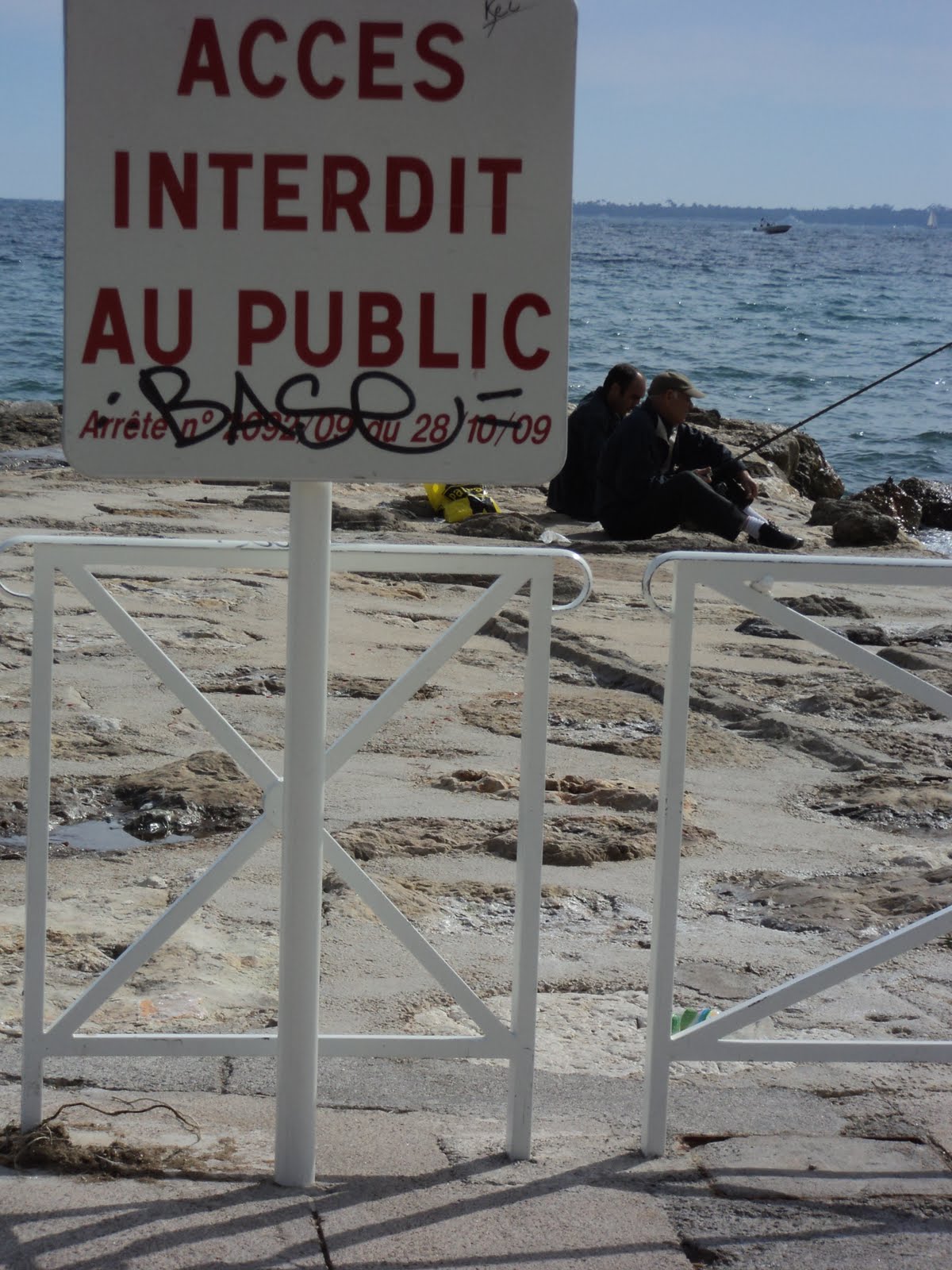
The Blog of "No"by Jane Tolbert


Signs tell what we can or cannot do in public places like city gardens or on the beach. One sign, the Defense dáfficher (or no posting), always carries the footnote-like citation, the Law of 29 July 1881. This law enables the town halls to designate locations where announcements can be posted. I have seen few of these public bulletin boards. The ones I have seen are in inaccessible places.


According to a municipal decree of 7 August 1987, no one can leave trash or damage the walkways and equipment. Kick ball games as well as petanque (!) are prohibited as are bikes and dogs. Tricycles are allowed.


Numerous activities are not allowed--camping, camp fires and dogs for starters. But barbecues are strictly forbidden.


Swimming and small children are permitted.


But here, both diving and jet skis are prohibited, but not yachts lining up for parties associated with the Cannes Film Festival. And no one mentioned swimming and diving dogs.


Some signs justify a decree (no parking) with a type of footnote citing the Code de la Route (driving regulations). Others provide the rationale--no parking because firemen need access, the tourist train leaves from here, a market takes place here in the morning. . . .


The fisherman can fish in peace. Tourists and bathers dare not venture beyond the Forbidden to the Public sign.


In an enviroment of "no," it is refreshing to see courteous signs. Please do not slam the gate or please keep the gate closed.


But maybe what lurks behind the gate is the reason for keeping the gate closed. This mean dog must have gotten out at least once. If the sign is any indication of what a Chien Mechant could do to a person. . . .

Tuesday, May 11, 2010

Red Carpet and Weather. . . by Jane Tolbert


Photo sent via iPhone of May 4 storm.


The 63rd Cannes Film Festival takes place from May 12 through May 23, 2010. Hotels are usually crowded. Streets are packed with exotic cars. Throngs of tourists linger, hoping to get a glimpse of . . . .you name it, any of the stars or producers or just the rich and famous.

The region is primped. Palm trees. White sand. Lavish receptions. Well, that had been true until recently. With the recession, even the rich and famous are having to curtail activities. The main concern now is the weather.


Juan-les-Pins beach in February

The joke about the Cannes film festival has always been the weather. The locals agree, it rains during the festival. The Cote d’Azur might have had perfect weather between Easter and the festival—turquoise- azure seas, for which the region is famous, sunny skies and white beaches—all of which provide great photo opportunities. The opening of the festival generally brings gray skies and diluvial rains. In response to the meteorological challenge, several years ago organizers moved the festival to a later date in May.

Tourist season begins with Easter, intensifies during the festival and then continues through August. Preparation for the migration begins in late February or early March, with the clearing of the weather and subsiding of winter storms on the Mediterranean, which have eroded coastlines.

Beginning in late February, the operators of the private beaches import sand and palm trees, restore buildings, bring in tables, chairs and brightly colored umbrellas. They will rent the lounge chairs for 10 Euros the half day, serve grilled fish or meats and Mediterranean specialties, le tout arosé de vin et de champagne, to international clients as well as locals, all of whom relish a chance to dine with the view of the red Estérel Mountains, the azure sea and their feet in the warm sand.

But this year has been exceptional. The nice weather, which gave everyone hopes of a longer beach season, was cut short by what the Nice Matin (May 9, 2010) termed the “coup de mer dévastateur” of May 4,2010. The waves, which reached six meters, carried away tables, chairs, palm trees and the bright umbrellas. Quickly, an “armada” of workers and machines began to restore the beaches. Already in Nice, five of the 15 private beaches had reopened within days of the violent waves.

This year has brought other unexpected challenges, such as the eruption of the volcano Eyjafjallajokull , which began spewing tons of ash on April 14, resulting in stranded airline passengers and empty hotels. One luxury hotel manager in Juan-les-Pins said that although some of the hotels had canceled reservations, the clients stranded on the Cote d’Azur extended their stays.


Normal winter erosion (photo from December 2008)

The organizers of festival have changed their dates to meet challenges of the weather. And the beach operators got an early start on the season. No one could have predicted exceptional waves or the eruption of a volcano with a name that few can pronounce. In the next few days, we will see what the weather brings for the red-carpet event.

Wednesday, May 5, 2010

Job Applications--It's in the Details by Jane Tolbert


Job entries on CadreEmploi

Those of us who applied for jobs in the pre-Internet days remember the process of carefully crafting a cover letter (after doing research using business reviews and annual reports held at the library), printing copies of our resumes on high-quality paper and mailing our submission package to the human resources department.

When I returned to the job hunt recently, I welcomed the change to paperless applications, which seemed to work like this: locate job through a Google keyword search, upload resume, submit. My candidacy package would speed through cyberspace to its destination. One detail made this application process something other than the panacea I expected. USABILITY.

Employment opportunities are posted on job boards (CareerBuilder and Monster in the States or CadreEmploi and the French Monster in France) or just about anywhere on the “net.” The search was actually fun. I found jobs for which I was qualified. But when I clicked on the button that said, “Apply online,” instead of being taken directly to the job description, I was taken to the homepage of the company advertising the position. From here, I needed to go to the career page menu and search through the jobs.

Step 1, CREATE ACCOUNT. Name and address. Provide a user name and password. ERROR MESSAGE. Error fields are marked with an asterisk. Provide a valid email address. SUBMIT. ERROR MESSAGE. Your password must contain between 8 and 10 characters and at least one capital letter and one numeral. My screen went blank. I returned to the corporate website to begin the login process anew. ERROR MESSAGE. That user name has been taken.

Locating a job was one thing, but creating the user account presented unimaginable obstacles. More than 30 minutes into the process, I succeeded. Step 2, CREATE PROFILE. Companies provided various options for an online resume of education and professional history—upload a resume or cut and paste to a textbox. Some sites proposed a “resume builder,” which, in theory, “populates the form,” or takes information from a resume and places it in appropriate boxes. In practice, the software succeeded with name and address, but employment history and education became garbled and contained numerous errors. Other forms enabled me to fill out my job history myself with a series of pull-down menus and submit buttons. But even that activity was fraught with minefields. Some forms forced me to select a category of industry or job. And, although I could fill in the blank for city location of employment, I had to use a drop down menu for the state in which I worked. Given that some of my experience is international, I looked for France or international or other country, to no avail. I finally left that entry as city France in the state of Florida.

ERROR MESSAGE. Your file has to be loaded as a PDF or in MSWord and must not exceed. . . . YOUR APPLICATION has not been accepted until you receive a confirmation number. ERROR. You must answer all questions concerning criminal history, veteran’s status and security clearance. ERROR. Although information about race/ ethnicity is optional, you must select “not disclose” if you choose not to disclose that information.
Some applications seemed more encouraging than others. On one, a horizontal bar showed the progress of my application. Some applications allowed me to return to previous pages, or to preview and edit material I had entered. But others erased information if I pressed a back key. The only thing consistent is that these applications required a lengthy amount of time, much more than the paper copies I had mailed years earlier.
Other countries use similar online application forms. But French resumes require photos, which make files exceed the maximum limit.

Today, I visited two sites, one of which gave me a choice to apply via a personal email with attachments or via the online form. (I feel good about this company already.) The other company must have had a glitch—the job board sent me to the company website, which then sent me back to the job board. I found the snail mail address, and that application is going by the USPS.


# # #

My questions for readers--Have companies actually tested their online job application process? Or does the time-consuming application process actually reduce the pool of applicants? Hummm.