Wednesday, October 27, 2010

Almost business as usual by Jane Tolbert


Sunrise at Destin


It seemed like just another day on the beach. Sand crabs scuttled about, but when a shadow passed, they made quick dashes to their holes. Dogs romped happily. Seagulls lined up facing the gulf. Sunrise and sunset were spectacular performances from the beach and hotel decks.


Almost business as usual except for the dearth of tourists. Those few beach goers were there for two conferences held at the Sandestin Hilton.

Cabanas on the Destin beach


A few locals attributed the drop in tourism to the negative media coverage and misconceptions that followed the Deep Horizon disaster of April 2010. The print media continue to revisit the issue with headlines like "Florida Panhandle hotels hurt by oil spill's effect" (LA Times, Oct. 23, 2010) or "Oil Fears Still Crimp Tourism" (St. Pete Times, Oct. 14, 2010).


Destin is located between the Gulf of Mexico and the Choctawhatchee Bay (I had to look up the spelling but wouldn't attempt to pronounce it), about 30 miles south of I-10. On my first trip to the Emerald Coast, I walked barefoot on the powdery white beaches. I found no tar balls but only a few unwanted visitors--jellyfish and minuscule Portuguese Man of War brought in with the wind and surf. I dined with a friend in the Baytowne Wharf area. No waits for a table on the terrace, and only a few parents pushing strollers or pedestrians with dogs on leashes wandered the streets.


On a more positive note, the Hilton offers fantastic accommodations. Its rooms go beyond the wild expectations of most parents--a sleeping area for kids that is separate from the bedroom/ sitting room and balcony for adults. Additionally, the hotel has indoor and outdoor pools and play areas for kids. Of course, when my kids were small, I never could have afforded these accommodations! But as a conference participant, I received great rates.

The hotel includes the 13th floor


Miles of nature preserves border this highly developed area of hotels, spas and golf courses.


The true test of a successful beach town--would I return? Long drive. No tango, but friends. Not the delightful bustle of South Beach, but peace and calm. Night activities (Fourth of July and New Year's) within what a Swedish friend called "crawling distance" for those who imbibe sound tempting. . . . But could someone tell me what is a bomb shot?

Wednesday, October 20, 2010

In Search of Skink and Tea Cake by Jane Tolbert


Now that I have moved from Melbourne, I can return as a tourist and visit new places. As a long-time Florida resident, I really wanted to meet some of those quirky characters described by Carl Hiaasen and Zora Neale Hurston like Skink in his shower cap or Tea Cake!


Florida is a land of contrasts. After leaving the glitz of the Mall at Millenia, I stopped at the Lone Cabbage Fish Camp, located on SR 520 just west of Cocoa on an isolated stretch of road. The place is known for its airboat rides, which cost $22 and take visitors at speeds of up to 45 mph through grassy marshlands where the St. Johns River blends and meanders in marshy wetlands. According to the ads, the “Lil’ Twister” costs a little bit more. No quirky characters—just tourists, a fly yellow Corvette and some fancy duallies lined the sand parking lot. No wildlife either. But tourists there lined up for local fried specialties—gator, turtle and catfish—and airboat rides.


Beachside, the narrow barrier islands nestled between the lagoon and ocean, has been known as the “best kept secret.” Long known to surfers and turtle watchers, it’s also an area of restaurants and small cafes, quiet beaches. The mom and pop motels have been replaced by chains. Gated communities. Paved bike paths. Panera Bread and Starbucks. Families on bikes and roller blades. No drunks, bums or former governors in shower caps. Any semblance of quirky had become gentrified.


Maybe if I tried US 1? Or would I have to go to places like Everglades City to experience the characters of novels? That would have to wait for another trip.

The drive north on I-95 from Melbourne to Ormond Beach took me past endless developments, then endless miles of cabbage palms (our state tree). At Route 40, I joined the lines of motorcyclists, which had come to Daytona for Biker Fest. Bikini clad bikers, boots, tattoos, long hair, military pants and generally no helmet. They traveled as an orderly group, but they took over parking lots and lanes of road.


Past Barberville with its junk yard that now that carries 10-foot tall pink, cast-iron chickens, flower pots and just about anything else. Past Astor, which has Blair’s Jungle Den, a drawbridge and waterfront cafes and what looks to be a 1,000 year old oak with a plaque commemorating the travels of William Bartram. Billboards advertise whoopie pies, road signs warn of bears for the next 23 miles, and there are always trucks selling peanuts.

I drove into Gainesville just after 90,000 Gator fans settled in for the homecoming game against Mississippi State. Turned out to be a quiet evening. The Gators lost the third game in a row. Anyway, quirky characters didn’t usually wear orange and blue or attend tailgate parties.

5:54 a.m. Sunday morning. The squeaky wheels of a shopping cart grated over the rough pavement. The sounds of bottles and tin cans.
“Where are you you little monkey? I’ll git ya!” Of course, the monologue, peppered with curse words and obscenities, has been toned down somewhat.
From one of the houses, the sound of “Shhhhhh.”

“Don’t SHHHHH me!” And the character began to thrash the bushes in the marshy woods across the street, a place most of us would not venture in the daytime, not to mention the early morning hours, when hoot owl and predatory birds scream as they swoop down for a kill.

Tea Cake, who had been bitten by a rabid dog? One of the governor’s developers he had abandoned in the swamp? And did I really want to find out at 5:45 a.m.?

Tuesday, October 12, 2010

Graffiti for the Cure by Jane Tolbert


Graffiti for a cause

Years ago, our great aunt asked us to look at an inscription left by an ancestor in the tower of St. Gatien in Tours (12-15th centuries, Loire Valley). It was a foggy, rainy cold day. When we arrived, we asked the guard about the inscription. He quizzical look made us think he did not understand us or care.

We climbed the tower. But instead of the inscription of our ancestor, we found walls covered with chiseled marks and graphics, attesting to the passage of centuries of graffiti artists.

Did that many people have that much to say? Or did they just want to say they had been there?

Cities have devoted millions of dollars to cleaning buildings of graffiti. But in Gainesville, we have a wall, which has been known for decades as graffiti friendly. On a regular basis, what has been called a “cement blog” carries news of engagements, makeups or breakups, birthdays, sports rivalries, as well as a permanent commemorative section to the slain UF students. Some of the graphics are hastily done, sloppy, but others seem worthy of a portfolio of a graphic designer. Usually, students work in teams, often at night, with shopping carts from the nearby Publix loaded with paints and brushes.


In the past week or so, a group of students painted a large portion of the wall pink in recognition of Breast Cancer Awareness Month. This pink wall attests to a growing recognition of the need to bring talk of the cure into daily parlance and into a series of activities that promote awareness—a tango for the cure, led by our UF tango faculty advisor and his fiancĂ©e, emails (in all languages)—une “CHANDELLE pour le cancer
Tout ce qui est demandĂ© c'est de garder cette flamme en circulation.”

The message is early diagnosis can save lives. This graffiti wall, unlike that in St. Gatien (which may have a popular culture value, however) carries a worthy message. But is everyone listening? And is healthcare accessible to all who need treatment?


Tuesday, October 5, 2010

The evening the bats ran late by Jane Tolbert


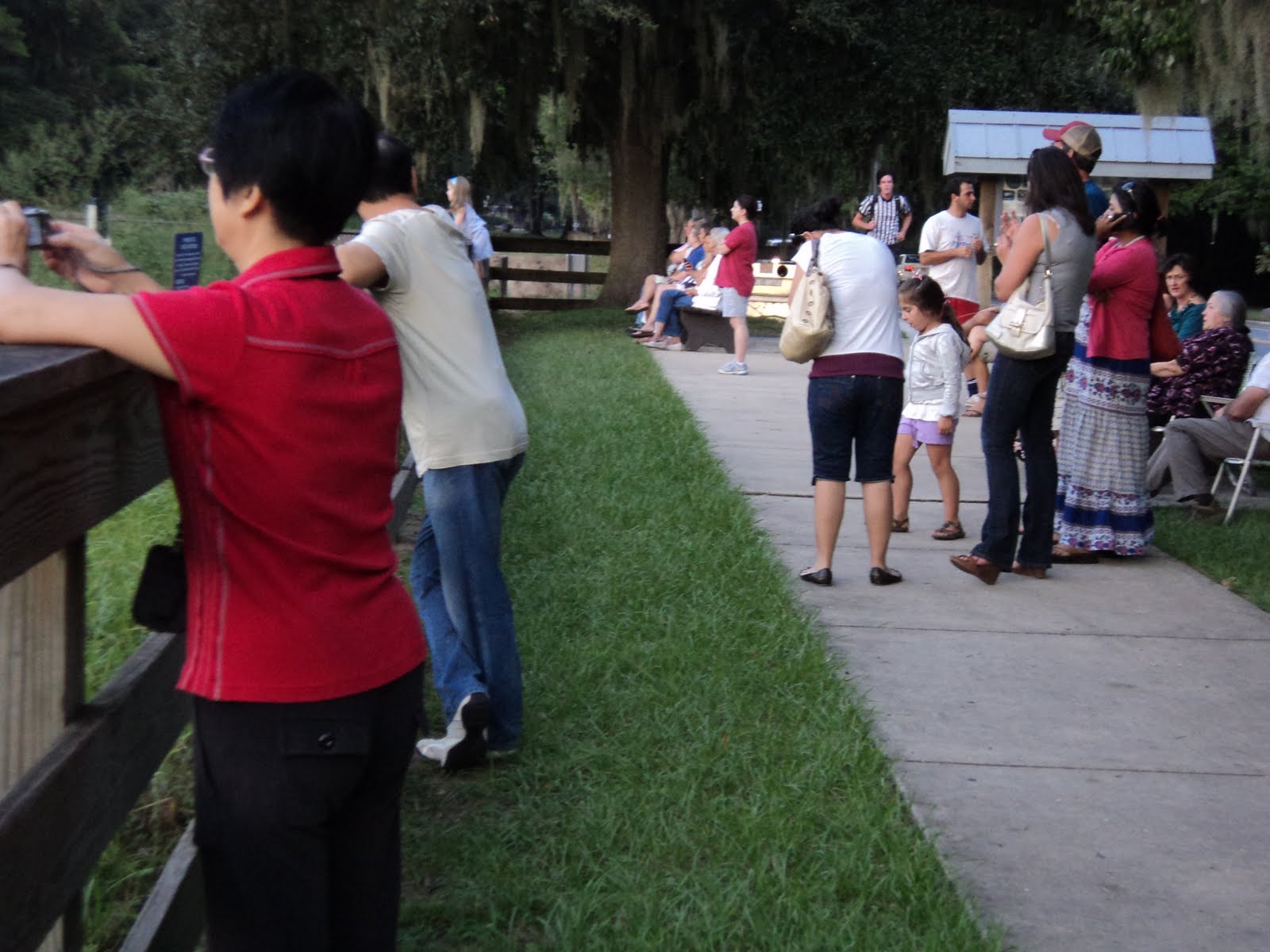
An international crowd gathered, some in flip flops, others in saris, others looking quite the Americans with lawn chairs. . . .All were there for a reason—to watch bats emerge from two bat houses that stand across from Lake Alice on the University of Florida campus.

Accounts on internet sites estimated that more than 100,000 bats would emerge around sunset, streaming out, ribbon like, from the bat houses. The crowd began to gather early, about 20 minutes before sunset, the time when the bats were to appear. It was cloudy, slightly cooler. Maybe the bats would emerge ahead of schedule.

Some people leaned on fences. Others sat on benches. Twenty, then 30 minutes passed, and still no bats. As the moment approached--official sunset was at 7:11 p.m.--we became slightly restless, just like in a theatre when we await the KNOCK KNOCK KNOCK that signals the beginning of a performance.

Cars paused to allow pedestrians to cross—kids and parents, babies in strollers, a lady with her foot in a cast. Sunset had long since passed, and it had become chilly. Where were the bats!


Given descriptions of the bat phenomenon told of a wide, black, fluttering wave, any motion caught out attention in the growing darkness. Did I see a wayward bat or dragon flies, small birds. . . .I looked for any sign.

When the bats finally made their appearance, we almost missed them. No streams of bats appeared against a slightly lighter sky, but instead only a slight flutter of leaf-like wings appeared when their rose toward the sky. Our poised cameras did not pick up bat images but only the silhouette of spectators in rapt attention.

Maybe the bats need the three knocks to signal the start of the performance earlier.